It’s not a stretch to say that this tutorial is going to blow your brains off. In this tutorial you will learn how to move around any obje...
dailyvideo
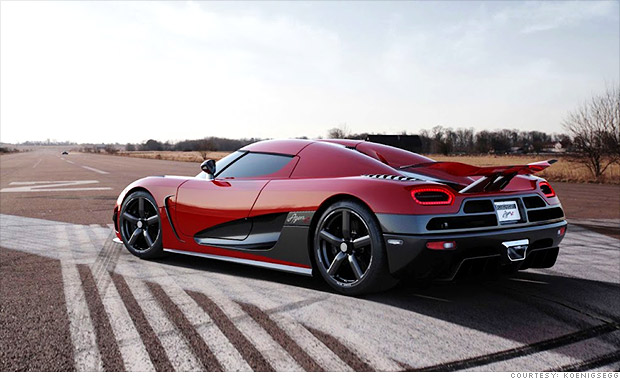
1.Koenigsegg Agera R
Base price: $1.5 million
You've
heard of Lamborghini and Ferrari. You've even heard of even heard of
Lamborghini's seven-figure cousin, the Bugatti. (Both are part of the
Volkswagen Group.)
But,
for those looking for something their neighbors don't already have,
there are a number of lesser known supercar makers out there peddling
products that are even more exotic.
Swedish
automaker Kooenigsegg, for instance, offers the Agera R, a car that
squeezes 1,140 horsepower out of a 5.0-liter twin-turbo V8.
Koenigsegg
only produces about 15 cars a year. For regulatory reasons, the Agera R
may not continue to be sold in the U.S. after this year but buyers can
still get one if they order soon, according to Koenigsegg.
2.Pagani Huayra
Base price: $1.1 million
The
Huayra, pronounced "why-rah," is named after the ancient Andean wind
god Aymara Huayra Tata. It's powered by a 6-liter twin-turbocharged
12-cylinder engine produced by the AMG division of Mercedes-Benz. Much
of the car's structure, particularly the area around the driver, is made
from a strong, lightweight and very expensive material called
carbon-titanium
Based
in Italy, Pagani's entry into the United States was delayed by a
regulatory squabble over the car's airbags. That issue has been worked
out and cars will be delivered here next year, said Brett David of
Prestige Imports, which sells Paganis in South Florida.
3.Zenvo ST1 50S
Base price: $1.8 million
It
is highly unlikely, to put it mildly, that you will ever see a Zenvo
ST1 50S on the streets. Only three will be made for the United States,
for a total of 15 cars worldwide.
The
Danish-built 50S is designed specifically for the United States and
it's slightly different from the 12 other ST1's that will sold in other
parts of the world.
One
50S has been bought in the United States. But it was immediately
shipped off to China, said Bobby Kahn New Jersey's Empirio Motor Group,
Zenvo's sole U.S. dealer.
4.McLaren MP4-12C Spider
Base price: $265,750
The
McLaren isn't quite in the same league as other cars in this gallery.
It's much lower in price and horsepower than the others and produced in
higher volumes. In any other, context, however, this would be a fast,
rare, and expensive car.
The
McLaren MP4 is powered by a rather small 3.8-liter V8 producing "just"
592 horsepower. McLaren expects to sell as many as 600 cars a year in
the U.S, including both the coupe and the drop-top Spider, shown here.
McLaren's
goal was never to produce an outrageously expensive and intimidating
supercar but an "ultimate sports car" that could be comfortably driven
on a daily basis.
5.Hennessey Venom GT
Base price: $1.1 million
Texas-based Hennessey Performance is a company that specializes in "making fast cars faster," according to the company's motto.
Most
of the cars Hennessey sells are highly modified versions of well-known
cars such as the Ford Mustang, Chevrolet Camaro and Dodge Challenger.
The idea for the Venom GT came as company founder John Hennessey
wondered what to do to top his ultra-high performance version of the
Dodge Viper, a car that was already faster than a Bugatti Veyron.
The
1,244 horsepower Venom GT's body is taken from the Lotus Exige. Beyond
that not much remains of the donor car. The 7.0-liter V8 engine,
transmission and cooling are pretty much all new, according to
Hennessey.
6.Shelby GT40
Base price: About $170,000
You've
probably heard of the Ford GT sports car, which was produced for only
the 2005 and 2006 model years. You may also have of the Ford GT40
racecar it was based on, which raced and won -- a lot -- in the early
1960s.
This
is the Shelby GT40 built by Shelby American Inc. Carroll Shelby helped
create the original GT40 and the Shelby GT40 is a faithful reproduction.
Over two thirds of the parts in this car are interchangeable with an
original Ford GT40 racecar.
The
Shelby GT40 stays close to its racecar heritage. That means it doesn't
come with airbags, or stability control, or anti-lock brakes, or
basically any of the standard safety equipment required on modern cars.
First unveiled at the Frankfurt motor show last year, Ford Europe’s
EVOS concept was a gleaming look into the future of auto design. We’re
sorry to break it to you that the EVOS itself won’t be coming to
dealers; this sporty plug-in is part of Ford’s plan to exploit
revolutionary technologies that will define the next generation of their
vehicles. Envisioned through Ford’s Kinetic 2.0 design language that integrates
technical efficiency with a refined body, the end result is meant to
portray an increasingly premium feel to vehicles that are more
individualized than mass produced. With a look that hints of an Aston Martin and wings reminiscent of a
Mercedes SLS, the four angular doors pull away from the vehicle in a
diagonal fashion, giving this roadster a high-tech Batmobile feel. No stats have been, or will be, released for this concept; the
designers have envisioned this beast as a cloud-optimized plug-in hybrid
which “maximizes efficiency by selecting the best combination of
all-electric and hybrid modes to suit the predicted travel route.” This
ability gives it the opportunity to switch its emissions based on future
restrictions that may come into play. The cloud-vision system further integrates social media and driver
preferences to create a truly custom experience when on the road. The
clean-cut interior features bright, customizable touchscreens which will
be used in upcoming ford models. Combined with ergonomically-designed
bucket seats, this 2+2 shows off its versatility when the rear doors
rise on their hidden hinges, revealing the back interior. Though, the
most fascinating thing we found is the single piece of flowing glass
that connects the front and back windshields, creating a uniform sexy
back form. We just hope that at Tokyo or Frankfurt coming up, Ford will change its mind and put this baby into production! Check out the concept video below, as well as the slick photos in the gallery.
After a sneak appearance in Los Angeles prior to its debut at the
Beijing Auto Show this week, Mercedes-Benz ushered in the
next-generation of luxury design for the company with its dramatically
sexy Concept Style Coupé. Strikingly dynamic in its bold masculine styling and decent power
output for a smaller executive sports car, the CSC sets a
strong precedent for its structure design, which focuses prominently
upon eye-catching surface body lines on the hood and sides. These focal
lines succeed in drawing the audiences’ center of attention from the
futuristic aggressive anterior, to the tapered, conservative rear. Two additional features we love on this vehicle (and can’t be
forgotten upon seeing them) are the front lights and rims. The
fascinating headlights, which encompass a successive light-up system
similar to a keyboard; these frame the glaring red standby lights, which
alone have the effect of a murderous creature about to ambush its prey.
We strongly suggest you check out the video below to see what we mean.
The turbine rims, which are set within respectable 21-inch rubbers,
are also a favorite compared to the nonsensical and boring designs we’ve
seen recently coming out of China. Not only are they decisively unique
in their flared and sporty design, they kind of remind of us of ninja
stars, which makes for all kinds of awesome. The turbine rims, which are set within respectable 21-inch rubbers,
are also a favorite compared to the nonsensical and boring designs we’ve
seen recently coming out of China. Not only are they decisively unique
in their flared and sporty design, they kind of remind of us of ninja
stars, which makes for all kinds of awesome. Inside this beast lies a relatively economical 2.0-Litre
four-cylinder engine with exhaust gas turbocharging; which combined with
Mercedes’ heavily reliable dual-clutch 4MATIC auto transmission,
provides for optimum power and handling. The interior of this bucket-style four seat coupe utilizes a
sports-style dash, with a highly-sculpted instrument panel that is
reminiscent of Chevy’s Camaro interface but with a touch more class and
sophistication. While we’re hesitant to praise the lime green accenting
in the production concept, we’re fairly confident additional choices
will be available if it makes it to the showroom floor. That being said,
we like the racy feeling of the cabin especially with the generous
glass ceiling overhead. Our guess is that most experienced drivers would be more than
happy to take the CSC for a spin, and if our sources at Mercedes are
correct, we could potentially be seeing a production variant as soon as
2014.
ENGINE: 2.0-Liter, 4-Cylinder, Direct-Injection
HORSES: 211 HP
HANDLING: 4MATIC Dual-clutch AWD
CONSUMPTION: TBA
PRICE: TBA
AVAILABILITY: TBA 2014
If you've recently seen a mysterious badass bimmer stealing the ending scenes of Mission Impossible: Ghost Protocol, then let us introduce you to, (or re-introduce, if you're a car fanatic) the BMW i8 Concept. This smokin' hot, futuristic ride is one of the first models of the
new BMW i sub-brand which starts launching emission-friendly vehicles in
2013. This hybrid-electric utilizes an impressive dual-fuel system
that allows it to operate at around an amazing 80mpg. Combined with the
capability to go 0-60 in a reported 4.8 seconds, this car is made for
those who want the speed
talian luxury sports car god Ferrari unveiled their new flagship grand
tourer earlier this month: the 2013 F12berlinetta. Replacing its
prototype, the six-year old 599 Fiorano, the F12berlinetta was conceived
as the first of a new generation of powerful V12 vehicles for the
company. Making its world debut online at Ferrari.com and making an
appearance at the Geneva Auto Show, this high-performance road demon is
being promoted as the fastest Ferrari ever built. Packing in 729 horses at close to 8250 rpm, the F12berlinetta features a
custom-designed 65 degree twelve cylinder engine and its cool 508 lb-ft
of torque easily tops its predecessors’ 448 lb-ft. The top speed for
the F12 is in the range of 210 mph, and has the ability to get from 0-60
in a mere 3.1 seconds which eclipses the 599 Fiorano’s time of 3.7. If
you're going to test fate and try out these speeds on city streets, just
make sure you’re more sly than the doctor in Japan who recorded his
thrill ride and found himself facing jail time after the police watched
it on The external body of the F12 strikes a balance between the latest in
aerodynamic technologies and sophisticated traditional Ferrari touches.
The use of fluid dynamic simulations, along with extensive wind tunnel
testing has optimized this strikingly beautiful car for less drag and a
higher rate of downforce to help keep your car on the road. The body
itself was designed collaboratively between the Ferrari Styling Center
and distinguished Italian auto design and engineering firm Pininfarina. Lastly, the classic Ferrari interior of this luxury roadster is
exceptionally roomy compared to previous models. Upgraded Frau leather
is used throughout, and is fashioned with futuristic looking air vents
crafted with aluminum and carbon fiber. The F12 is also surprisingly
fuel efficient at 30% below the Fiorana, and only emits 217.5g/mile of
CO2. The F12berlinetta is estimated to cost around $333,650 and will be available later this year.
A distant successor to the “Rambo-Lambo” military-style SUV
Lamborghini put out in the 1980s, the company’s newest venture is named
for the size and appearance of the urus, an ancestor of today’s Spanish
fighting bull. A behemoth next to the rest of the current Lambo lineup,
the Urus’s design is powerful, bold and streamlined. It definitely has a
presence in the auto sphere, but will it fly in showrooms? Launched last month at Auto China in Beijing, the Urus features a
proposed twin-turbo V8 hybrid system that can harness around 600 horses
while optimized to deliver best-in-class emissions. As an early concept
vehicle, the sporty SUV hasn’t been publically assigned additional specs
yet, but according to some reports, if there’s enough interest in the
Urus and the low-set platform it’s based on, owner Volkswagen Group
could move forward, possibly pushing the Urus out around 2017. While the exterior conveys a powerful, aptly bullish persona with
substantial hints toward the car’s precisely engineered aerodynamics,
the interior reminds us of something vaguely alien with new-age seats
that almost try too hard to grab attention. That said, based on
itsgorgeous Aventador J
we covered last month, we imagine that the company will integrate a
fair number of carbon-fiber elements in order to lighten the vehicle.
We’re a fan of the massive 24” wheels, and the sleek embedded LEDs and
TFT cockpit screens are welcome features.
The Urus follows in the footsteps of other luxury automakers hoping
to cash in on an SUV sports line. We are just as hesitant about the Urus
as we are about its competitors’ designs, such as Bentley’s EXP 9 F.
While the prospect of taking advantage of the market and creating an
SUV success, such as Porsche’s Cayenne, BMW’s X series, and MB’s M
series, is tempting, one has to realize that commercial viability under
the $100K price tag is much easier when you’re dealing with auto lines
that usually stay within that area. The 2012 Lamborghini Gallardo is
rarely seen below the $200K mark. Get the hint? While some critics may argue, “if you build it, they will come,” the
market for this type of vehicle (again, not attacking the Urus, but all
sport-luxury SUVs in general) entirely comes down to the market you are
aiming for. That is where our first clue lies. The future owners of
vehicles like the Urus aren’t primarily the American one percent, though
we wouldn’t count out a few movie stars picking one up to chauffer
their international collection of adopted children, but the more likely
scenario lies with the very market the Urus was strategically launched
in: China.
The rising class structures of tech-rich Asia, oil-rich former Soviet
countries, and the Sunni monarchs (and their many children) of the
Middle East will be where these cars could make their potential home.
Not only does a limited-production, astoundingly powerful SUV with
proven sports street cred make an attractive travel vessel, it also
makes a nice collector’s car for show. All in all, it’s a powerful streamlined beast; we’re just not sure
how successful this category of vehicle can be. Perhaps if one of these
carmakers were to see these concepts through to production, then we
could actually see if the interest is there. Who knows; it could be a
whole other ball game if the market is right.
If there was any doubt that an ultimate sports car bearing the name
“Vitesse” (French for speed), costing an estimated $2.25 million and
designated as the successor to Bugatti’s legendary Super Sport could
wind up being an orgasm on wheels, then you clearly haven’t heard of the
much-awaited 2013 Veyron 16.4. After years of development, this revolutionary roadster was unveiled
in Beijing in April. The auto world and fans alike can assure themselves
that this is one hot rod they’ll be able to see in a classics museum
somewhere down the road.
Using a custom-designed, absolutely excessive 7.9-liter 16-cylinder
engine in W configuration, the Vitesse’s maximum torque of 1106 lb.-ft.
delivers an astounding 1200 horses that will give the lucky bastard on
board an ego so big he’ll have to drive with the top down. The Vitesse owes its increased capabilities (from the Super Sport) to
the addition of four larger turbochargers with intercoolers, as well as
a reinforced and reconfigured drivetrain and chassis to help evenly
balance the immense power of the car and the stress placed upon the
components at top speed. Alongside numerous adaptations for larger air
intakes and vents, the new exterior roof spoiler helps with noise and
buffer reduction while on the road. When a vehicle has the ability to hit 62 from standing in just 2.6
seconds, it becomes almost humorous to imagine the scenarios that
require power of that magnitude. While our preferred fantasy for the
beast entails hightailing it to the Playboy Mansion for a last-minute
party in the grotto, we’d also entertain such far-fetched notions as
racing one of the Air Force’s F-35 Joint Strike Lightning II jets to the
end of the runway, breaking the land speed record for crossing the
continental 48 or scaring the fucking shit out of every last person on
Bolivia’s infamous road of death. The Stats: ENGINE: 7.9-liter W16 POWER: 1200 HP at 6,400 rpm TOP SPEED: 255 mph TORQUE: 1106 lb.-ft. QUANTITY: Production limited to 350 units PRICE: $2.25M
SEOUL, South Korea - The French-Japanese auto alliance of Renault and Nissan is investing $160 million in its South Korean Renault Samsung Motors to produce Nissan-branded vehicles mostly destined for the United States, taking advantage of the South Korea-U.S. free trade agreement and a more favourable exchange rate.
The investment, announced Friday, will help utilize unused capacity at Renault Samsung's Busan plant, which has cut production to 180,000 vehicles a year, well below its full capacity of 300,000 vehicles, as sales slumped at home and abroad.
The plant will use the investment to annually produce 80,000 next-generation Nissan Rogue crossover sport-utility vehicles starting in 2014. They will be shipped to North America and a few Asian countries, said Nissan Motor Co. Chairman Carlos Ghosn.
With the production of Nissan-branded cars, South Korea and the struggling Renault Samsung Motors are moving closer to becoming an export base for the Renault-Nissan Alliance, which has been expanding outside Europe and especially in Asia.
"Korea is a very competitive base," Ghosn said at a news conference in Seoul.
"The Korean government has done a great job in supporting this industry with very competitive foreign exchange rates, which has allowed the industry ... to really weather the storm very well and continue to expand."
Japanese automakers have been hammered by the strong yen which erodes profit from cars produced in Japan and then shipped overseas. To counter the unfavourable exchange rate, Japanese car makers have increasingly moved production abroad, making countries such as Thailand important auto production bases.
But Ghosn said Renault has no plan to increase the capacity of the Busan plant. "The 300,000 capacity that we have in Busan should be little by little filled."
The move to beef up production in South Korea is unique among major Japanese automakers. Toyota Motor Corp. and Honda Motor Co. do not have plants in South Korea.
The move is also noteworthy for taking advantage of a trade deal that Japan lacks. South Korea is ahead of Japan in such deals, and already has a free trade agreement with the U.S., and is negotiating deals with Canada and Mexico, where the Rogue is also headed.
Renault was the first European carmaker to set up operations in South Korea. In 1994, Nissan formed Samsung Motors Inc. with Samsung Group. In 2000, Renault SA of France purchased 70.1 per cent of Samsung Motors, which had entered bankruptcy in the wake of the Asian financial crisis, and renamed it Renault Samsung. Renault now owns 80.1 per cent of the manufacturer.
Analysts said the investment is Renault's quick fix for its ailing South Korean unit, which has been squeezed by nimble rivals Hyundai Motor and Kia Motors.
"It appears to be an emergency patch to push the factory operation back to the normal level, but it doesn't appear to be a long-term strategy," said Bok Deuk-kyu, a senior analyst at Samsung Economic Research Institute in Seoul.
The French carmaker had risen to No. 2 by market share in South Korea in 2003 thanks to the popularity of its SM5 model. But in recent years, it has lagged behind Hyundai, Kia and GM Korea, and is closely trailed by Ssangyong Motor.
The investment comes at a difficult time for Renault Samsung. In 2011, it lost 292 billion won ($256 million) and a plunge in sales had even set off speculation that Renault may sell the South Korean unit. Ghosn said the announcement underlined its commitment to Renault Samsung.
Its South Korean sales in the first half of this year plunged 33 per cent from a year earlier to 83,062 vehicles. Last month, South Korea's smallest auto player Ssangyoong Motor Co. sold more cars than Renault Samsung.
All automakers are eager to boost their business in rapidly growing Asia.
Renault expects to sell more than half of its vehicles outside of Western Europe next year, up from 37 per cent in 2010. Renault is aiming for 10 per cent market share in South Korea, up from 4.4 per cent in the first half of this year, and 7 per cent last year.
The alliance between Renault and Nissan was born in 1999, when Nissan was near bankruptcy.
Ghosn, who was sent in by Renault to turn around Nissan, is revered as a management role-model in Japan. Under Ghosn, Nissan has returned to strong growth, despite setbacks last year from the earthquake and tsunami disasters in northeastern Japan. The Renault-Nissan alliance sold a record 8.03 million vehicles worldwide last year.
A series of modifications for the R230 SL has been unveiled by German
tuners PP Exclusive.New 20-inch alloys feature in the pictures, although
rims up to 23 inches are on offer. The arches have been appropriately
widened by 25mm up front and 55mm at the rear. The car has been lowered
by 10cm via an electronic suspension module, the controls for which are
located on the steering wheel.
World's Fastest Cars:
1. Bugatti Veyron Super Sport: 267 mph, 0-60 in 2.4 secs.
Aluminum, Narrow Angle 8 Liter W16 Engine with 1200 hp, base price is
$2,400,000. Although the Bugatti Veyron lost the title to SSC Ultimate
Aero on March 2007, Bugatti challenge the record in Germany on July 10,
2010 with the new 2010 Super Sport Version and the Veyron once again
claims the title of the fastest car in the world at 267 mph. The
original Bugatti Veyron has a top speed of 253 mph, priced at $1,700,000
and equipped with 1001 hp, is a tie at 260 mph!
2. Hennessey Venom GT: 260 mph, 0-60 in 2.5 seconds, has a
6.2-liter LS9 Turbocharged V8 Twin Turbo V8 Engine producing 1200 hp,
has a price tag of $950,000. The Venom GT has yet to be tested and
proven, but could possibly hit a top speed of 275 mph. This might just
be the Veyron Super Sport's closest competitor!
2. Koenigsegg Agera R: 260 mph, 0-60 in 2.9 secs. 5.0-liter
V8 Engine with twin turbo’s, housing 1099 hp. Base price is $1,600,000.
If you're into snow sports, the Agera R can be fitted with a Ski Box as
well as winter tires, not that I would take one on a ski trip or
anything like that. While the Agera R has a massive theoretical top
speed, the current tested top speed is 260 mph. Expect this snow car to
be the Bugatti's arch enemy for the next 5 years. Also a tie for #3.
3. SSC Ultimate Aero: 257 mph, 0-60 in 2.7 secs. Twin-Turbo V8
Engine with 1183 hp, base price is $654,400. Tested in March 2007 by
Guinness World Records, The SSC Ultimate Aero was the fastest car in the
world from March 2007 to July 2010. On March 2011, the Koenigsegg Agera
R also surpassed it, forcing this American made car to the #3 spot.
Shelby SuperCars will continue their quest to reclaim the fastest car
title, and their new SSC Tuatura might do the job (we'll just have to
wait).
3. 9ff GT9-R: 257 mph, 0-60 in 2.9 secs. 4.0 Litre V6
Twin-Turbo Engine with 1120 hp, base price is $695,000. Based on the
Porsche 911, the 9ff GT9-R 1120 hp version is limited to 20 units and
the exterior may be modified to suit the .owner
4. Saleen S7 Twin-Turbo: 248 mph,
0-60 in 2.8 secs. Twin Turbo All Aluminum V8 Engine with 750 hp, base
price is $555,000. Smooth and bad-ass. It will make you want to show it
off non-stop
.
5. Koenigsegg CCX: 245 mph,
0-60 in 3.2 secs. 90 Degree V8 Engine 806 hp, base price is $545,568.
Made in Sweden, it is the older brother of the Agera R, only losing to 4
other supercars in the world.
6. McLaren F1: 240 mph, 0-60 in 3.2 secs. BMW S70/2 60
Degree V12 Engine with 627 hp, base price is $970,000. The fastest car
in the 20th century with doors that looks like bat wings. Maybe Batman
needs to order one and paint it black
7. Zenvo ST1: 233 mph,
0-60 in 2.9 secs. Twin-Charged 7.0 liter V8 Engine forging 1,104 hp.
Base price: $1,225,000. The first Supercar from Zenvo Automotive, a
Danish sports car company in pursuit of speed and perfection. This 100%
Danish made supercar is limited to 15 units and the company even
promised "flying doctors" to keep your baby functioning.
8. Gumpert Apollo: 225 mph, 0-60 in 3.0 secs, 4.2 liter V8
Engine that houses 650 hp. Base price: $450,000. Gumpert claims that the
Apollo was designed such that it could drive upside-down in a tunnel
with speeds at 190 mph or above. Of course, no one has tested this yet.
.Noble M600: 225 mph, 0-60 in 3.7 secs. Twin-turbocharged
4.4-liter V8 Engine with 650 hp. Base price is $330,000. The Noble M600
also happens to be a very cool car. Its inconspicuous design sports a
slender and contoured body which does not scream out for attention at
every second of the day.
9. Aston Martin One-77: 220 mph, 0-60 in 3.4 secs. 7.3
litre V12 Engine with 750 hp. Base price: $1,850,000. The production of
this is limited to 77, hence the name One-77. This is beauty and power
packed into One.
9. Ascari A10: 220 mph, 0-60 in 2.8 secs. 5.0 litre BMW V8
S62 Engine with 625 hp. Base price: $650,000. The company planned to
produce 50 of these supercars at its factory in Banbury, England.
9. Lamborghini Aventador: 220 mph, 0-60 in 2.9 secs. V12
Engine with 700 hp, base price is $379,700. According to Lamborghini,
Aventador is the name of a Bull that entered into battle at the
Saragossa Arena on October 1993. This is the fastest bull in the world!
We have another 3-way a tie for 10th place:
10. Pagani Zonda Cinque Roadster: 217 mph, 0-60 in 3.4
secs. Twin turbocharged AMG V12 engine that produces 678 hp. Base price
is $1,850,000. The Pagani Zonda Cinque Roadster is a limited-edition,
with five ever produced. It is the quintessential exotic and exclusive
supercar.
10. Pagani Zonda Cinque Roadster: 217 mph, 0-60 in 3.4
secs. Twin turbocharged AMG V12 engine that produces 678 hp. Base price
is $1,850,000. The Pagani Zonda Cinque Roadster is a limited-edition,
with five ever produced. It is the quintessential exotic and exclusive
supercar.
10. Jaguar XJ220: 217 mph, 0-60 in 3.8 secs. Twin Turbo V6
Engine with 542 hp, base price was $650,000. Made in 1992, this car
still has what it takes to make the list.


 Kardashian was born in Los Angeles, California, the daughter of attorney Robert Kardashian and his wife Kris Kardashian (née Houghton). Her ...
 Carmen Electra is an American glamour model, actress, television personality, singer, and dancer. She gained celebrity through appearances...
 Lindsay Lohan’s career is back on track! It seems the actress is over her bad phase and is concentrating on her career. She recently wrapp...
 Chinaman's Hat Choose the Grand Circle Oahu Island Tour for a day trip filled with fabulous activities and sightseeing. The popular,...
 AN indecency complaint against Katy Perry and Aussie cricketer Doug Bollinger will go to court, it has emerged. The playful onsta...
 Halle Berry had a fall at work Tuesday night and sustained a minor head injury that sent her briefly to the hospital. The 45-year-old ac...
 GQ released some new Kate Upton pics from their hot photoshoot they did with her because GQ is milking the smartest move they’ve made in ye...